- Home
- Florida History
- Florida Heritage Sites
- Riverside Historic District Jacksonville
RIVERSIDE HISTORIC DISTRICT
By Mike Miller November 4, 2025
OVERVIEW
Riverside Historic District covers 687 acres west of downtown Jacksonville on the St. Johns River. The district encompasses over 30 subdivisions, including the three major ones: Riverside (platted 1868), Riverside Annex (1878), and New Riverside (1910s).
It includes three parks (Willow Branch Park, Riverside Park, Memorial Park), 16 churches, four public schools, two parochial schools, two fire stations, two hospitals, and a library.
The district joined the National Register of Historic Places in 1985. The area includes buildings from the late 1800s to the 1930s. Bungalows cover most lots, but mansions and apartment buildings also line some of the streets.
It is also home to Cummer Museum of Art and Gardens at 829 Riverside Avenue. The museum sits on the former estate of Ninah Cummer.
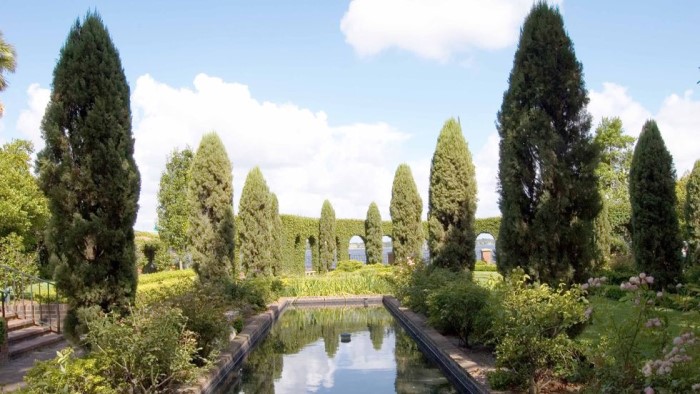 Cummer Museum and Gardens
The estate overlooks the St. Johns River, and its historic gardens and the original Cummer residence contribute to the historic character of the neighborhood.
HISTORICAL SIGNIFICANCE
Riverside originated from early 19th-century Spanish land grants, forming plantations like "Magnolia Plantation" (owned by Elias Jaudon, Sr., from the 1820s) and "Dell's Bluff" (granted to Philip Dell in 1801).
These focused on agriculture: cattle, cotton, rice, sugarcane, with supporting industries like cotton gins and sawmills.
White settlement in the Jacksonville area began in the early 1800s around a natural ford across the St. Johns River (once called "Cowford").
Development stalled due to events like the War of 1812, Seminole Wars, and economic depressions, but key landowners (e.g., Francis Richard, James Winter, John Forbes) persisted.
During and after the U.S. Civil War, Jacksonville was occupied by Union troops.
In 1901 the Great Fire destroyed downtown Jacksonville, so many families, including the Cummers, moved west to Riverside for safety.
In 1909 New Riverside subdivision opened and drew in more families. Streetcars extended to Willow Branch Park by 1911, easing commutes into the downtown area.
World War I spurred a building boom and then the city annexed the area in 1919, folding it into Jacksonville proper.
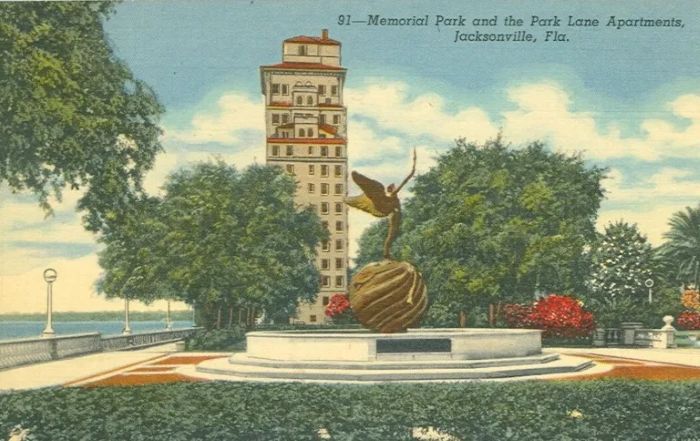 Jacksonville Memorial Park and Park Lane Building
Bungalows soon filled many lots through the 1920s. The Olmsted firm designed Memorial Park's landscape in that era.
Park Lane Apartments on Riverside Drive is adjacent to Memorial Park. The building was completed in 1926 and is currently occupied by condo owners.
Hospitals grew in the 1950s, anchoring the north end. Interstate construction later razed some blocks in the 1960s. Preservation efforts took root in the 1970s, and groups pushed back against further losses. Revitalization and protective ordinances now protect the district.
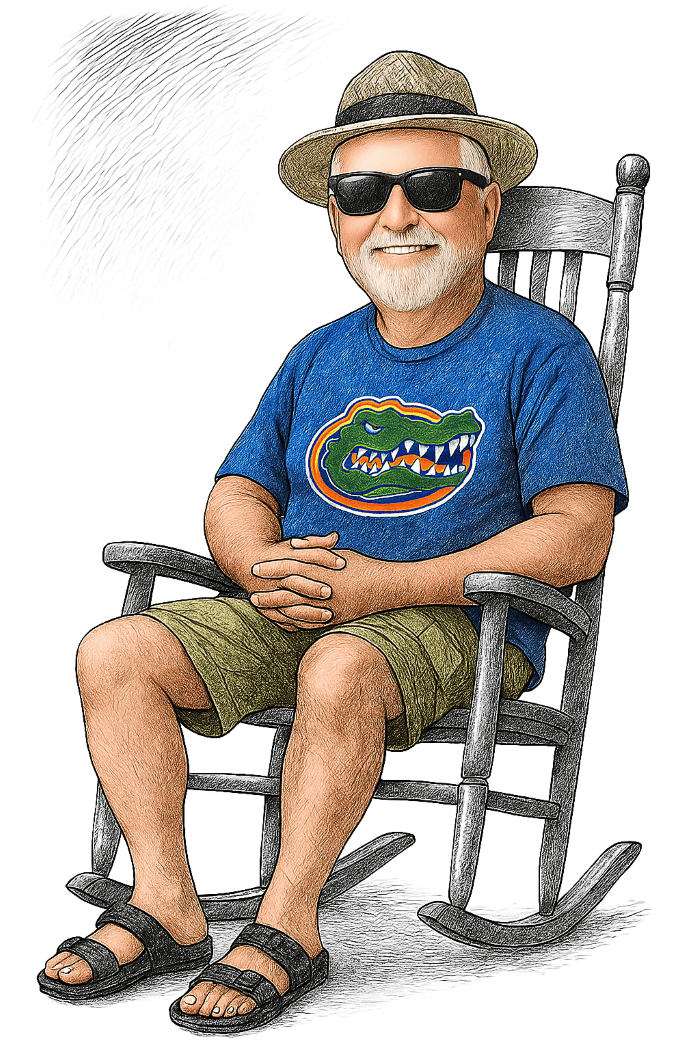
A Personal Memory of Park Lane Apartments
My first permanent home in Jacksonville was a U.S. Navy destroyer in Mayport. When I had liberty, which is a Navy term for being able to leave the ship, I used to love relaxing in Memorial Park on the St. Johns River in the historic Riverside district of Jacksonville.
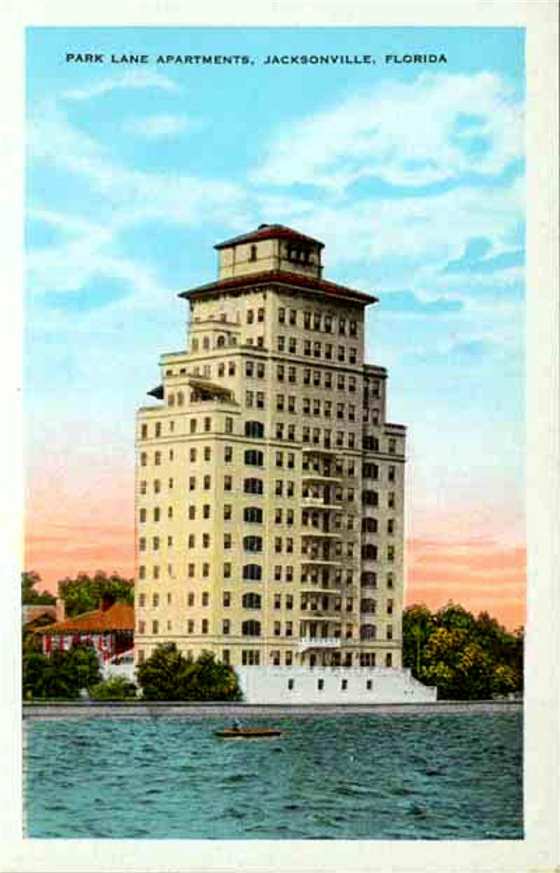
The park had a view of a magnificent building also on the river. It was known as Park Lane Apartments and was noted as being the first high rise condominium in Florida. It was built in 1926.
It was also noted for being home to some of the richest and most elite folks in Jacksonville.
I used to dream of someday being wealthy enough to live there. The building is still there and fully occupied, but guess what? I still don't live there.
Five Points is a historic, vibrant, and eclectic neighborhood in Riverside known for its unique shops, diverse restaurants, and lively atmosphere.
It is a pedestrian-friendly district within the larger Riverside area, characterized by a five-way intersection and a strong sense of local culture and history, which dates back to its origins as part of the Dell's Bluff Plantation.
The name comes from the five-way intersection where Park, Margaret, and Lomax streets converge, which has been a unique feature for decades.
The Avondale Historic District in Jacksonville is separately listed on the National Register of Historic Places and was added in 1989. The two districts are adjacent (Avondale lies immediately southwest of Riverside along the St. Johns River), but they are separate National Register listings.
Locally, the broader area is often referred to collectively as “Riverside-Avondale,” and the Riverside Avondale Preservation (RAP) organization covers both neighborhoods, but for National Register purposes they remain two distinct historic districts.
VISITING DETAILS
The district centers on Riverside Avenue and St. Johns Avenue. It stretches from Myrtle Avenue to the river.
Reach it via Interstate 95, exit 347 for Roosevelt Boulevard, then head west. No fixed hours restrict the area. Explore it on foot at any time during the day or enjoy driving around gawking at houses like I do.
INTERESTING FACTS
- Riverside Baptist Church is the only church designed by Addison Mizner, the flamboyant architect of great mansions in Palm Beach and Boca Raton. He was the most important individual in popularizing the Mediterranean Revival style in Florida during the boom years of the 1920’s.
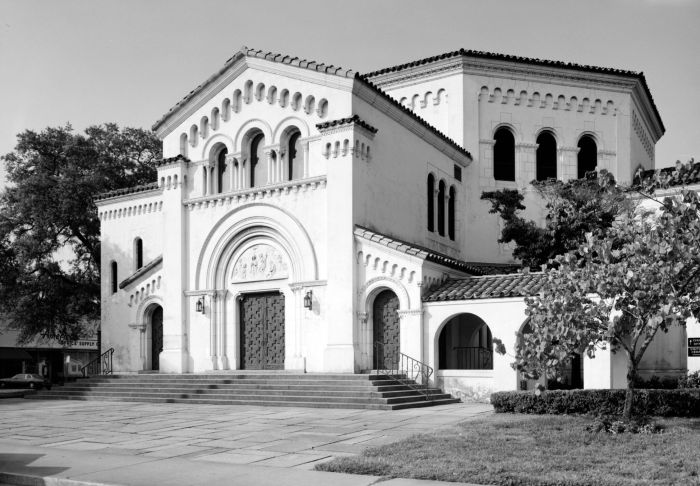 Riverside Baptist Church
Riverside exemplifies eclectic early 20th-century styles, reflecting national trends adapted to Florida's climate and local builders. Dominant forms include:
- Bungalow (c. 1910s–1930s): Nearly 60% of buildings; one-story, gable-roofed frame structures with clapboard or shingle siding, wide porches on tapered brick-based posts, paired 3/1 or 6/1 windows, exposed eaves, and brick fireplaces. Often from catalog plans by builders like J.E. Heagy.
- Prairie School (c. 1910s): Horizontal emphasis with stucco/brick, hipped roofs (sometimes barrel-tiled), multi-light casements; e.g., Roberts House (1914, 1804 Elizabeth Place) by W.D. Camp.
- Colonial Revival (c. 1910s–1920s): Symmetrical plans with classical details like columns and pediments; e.g., Lowenstein House (2814 Riverside Avenue). Later simplified versions blended with bungalows.
- Mediterranean Revival (c. 1920s): Stucco walls, tile roofs, arched openings, Spanish/Moorish motifs; e.g., Broome House (1855 Elizabeth Place) by Henry John Klutho; Lau House (2755 Riverside Avenue).
- Other Styles: Georgian Revival, Tudor Revival, rare Queen Anne, and vernacular frame/masonry houses. Multi-family units (duplexes/quads) in frame or Mediterranean styles.
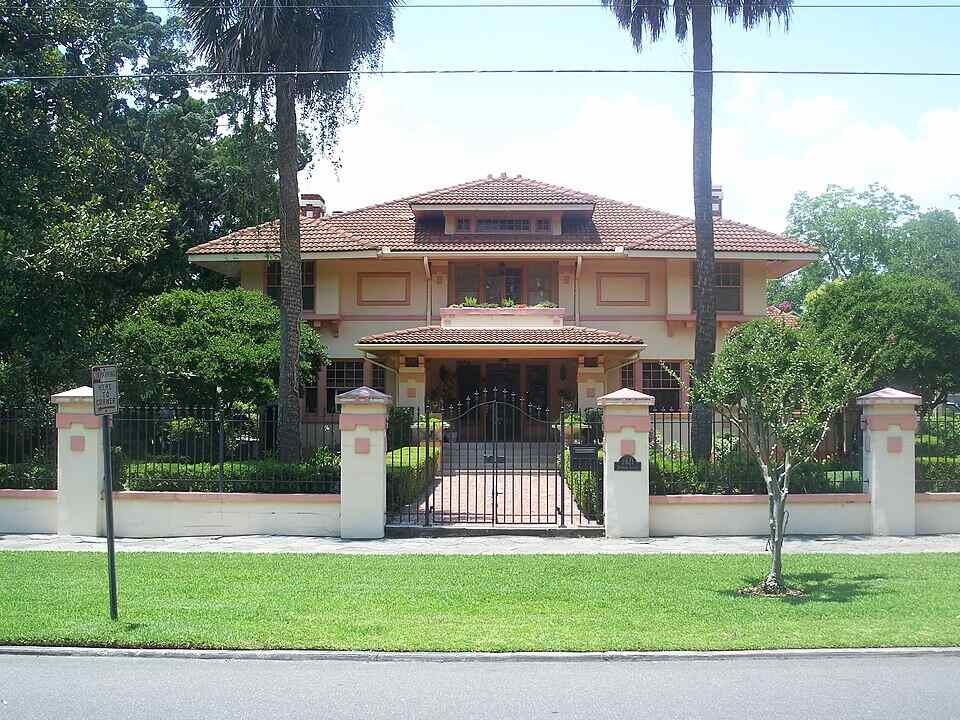 H.D. Smith house in Riverside
Notable architects include Henry John Klutho (West Riverside Elementary School), Addison Mizner (Riverside Baptist Church, 1925), and firms like Marsh & Twitchell (multiple homes).
The district's variety—spanning Frame Vernacular to Revival styles—makes it architecturally significant.
A Personal Memory of Riverside
My wife and I lived in an apartment on Cherry Street in Riverside shortly after I was discharged from the Navy in 1962. It was a great place to live with miles of sidewalks and shady parks.
My daughter was born that year at St. Vincent's Hospital in Riverside, the hospital where her mother received her Registered Nurse education.
A Navy shipmate got married that year in Riverside's First Baptist Church.
RIVERSIDE AVONDALE PRESERVATION WEBSITE
LOCATION MAP

Florida is the fastest-growing state in the United States and also the fastest-changing. If you see anything in this article that has changed or is in error, please let me know.
Thousands of Florida fans subscribe to our free daily Ezine, Florida Heritage Travel and we have 130,000 followers on Facebook.
By Mike Miller, Copyright 2009-2026
Florida-Back-Roads-Travel.com
Florida Back Roads Travel is not affiliated with or endorsed by Backroads, a California-based tour operator which arranges and conducts travel programs throughout the world.