- Home
- Florida Towns
- St Augustine
- St. Photios Greek Orthodox National Shrine
ST. PHOTIOS GREEK ORTHODOX
NATIONAL SHRINE
By Mike Miller January 5, 2026
OVERVIEW
St. Photios Greek Orthodox National Shrine is in the heart of historic St. Augustine, Florida. It’s housed in the 18th-century Avero House.
This sacred site honors the "Protoporoi," or first Greek pioneers, who arrived in the New World in 1768.
It’s the only national shrine of the Greek Orthodox Archdiocese of America in the USA.
Visitors enter through a courtyard garden, stepping into a world of Byzantine icons, relics of early saints, and exhibits chronicling Greek immigrant resilience.
St. Photios opened in 1982 after years of restoration. The shrine attracts over 100,000 pilgrims and tourists annually.
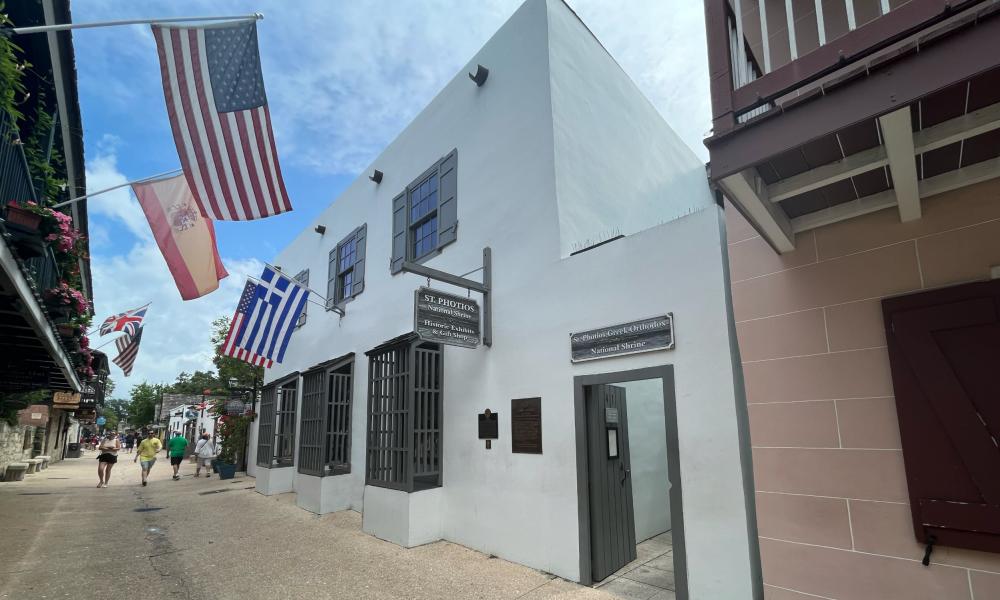 St. Photios exterior view
HISTORICAL SIGNIFICANCE
The shrine's story is woven into America's colonial tapestry. Avero House was built around 1749 during Spanish rule.
It has a two-story rectangular shape with an open loggia in the Spanish Colonial style. The walls are made of coquina stone and plastered inside and out.
The flat roof has several copper scuppers (openings in flat roof parapets that allow water to drain off).
The Averos fled to Cuba when the British took over in 1763. In the 1770s the house served as a hub for Greek and Minorcan immigrants fleeing persecution from the New Smyrna Colony.
Dr. Andrew Turnbull had recruited nearly 1,400 Greeks, Minorcans, Italians, and others for the New Smyrna Colony south of St. Augustine in 1768.
These were the first Greek immigrants to America. The settlers were promised they’d only have to work for three years, after which they would be freed and given title to fifty acres.
Turnbull never fulfilled his promise. Instead the settlers endured nine years of starvation, abuse, brutal conditions, disease, and exploitation under indenture.
Only about 600 of the original 1,400 colonists were still alive in 1777, when over 100 survivors fled north.
They found refuge in St. Augustine under British Governor Patrick Tonyn. He granted them the Avero House as a gathering place for worship and community.
This made it the first organized Greek Orthodox presence in the U.S. The site preserves artifacts, photographs, and documents of early Greek life and the Orthodox Church's growth.
In 1966 the Greek Orthodox Archdiocese purchased the property through local founders like George and Olga Fotiou.
They restored it to its 1700s Spanish colonial style, with coquina walls, tabby foundations, and wooden balconies evoking Florida's fortified past.
In 1971 architect Ted Pappas oversaw a redesign to integrate a chapel with Byzantine frescoes by artist George Filippakis, including relics of 18 early saints.
The murals are done in bold colors and gold leaf. The shrine is named for St. Photios the Great, 9th-century Patriarch of Constantinople.
The Avero House was listed on the National Register of Historic Places in 1972 as one of St. Augustine's 30 pre-1821 structures.
The full restoration project including museum, chapel, and courtyard was completed and officially opened in 1982 as the St. Photios Greek Orthodox National Shrine. The Chapel of St. Photios was consecrated in 1985.
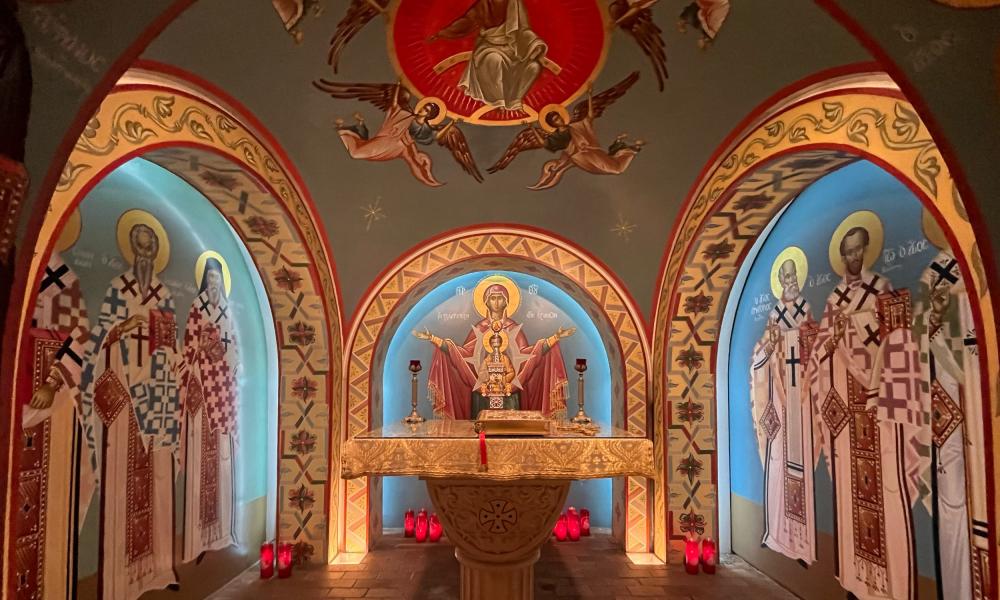 St. Photios interior view
VISITING DETAILS
St. Photios Greek Orthodox National Shrine is located at 41 St. George Street, St. Augustine, FL 32084, in the heart of the pedestrian-only historic district.
It is open daily from 10 AM to 5 PM and admission is free (though donations are warmly welcomed).
Plan on 30-45 minutes to explore the tranquil courtyard garden (with benches), the museum exhibits on the 1768 Greek settlers, and the small but stunning Byzantine-style chapel with its hand-painted frescoes and saintly relics.
Audio tours and candle-lighting are available in the chapel. The shrine can get busy on weekends, so weekday mornings are ideal for a quieter visit.
Modest dress is appreciated inside the sacred space. The gift shop offers icons, books, Greek food, and olive-wood items.
The Wall of Tribute lets visitors submit names to be remembered in prayer and commemoration.
It’s an easy walk from the Castillo de San Marcos, the Old City Gates, and the Catholic national shrine at Nombre de Dios, making it a perfect stop on any St. Augustine historic or spiritual itinerary.
ST. PHOTIOS GREEK ORTHODOX
NATIONAL SHRINE WEBSITE
LOCATION MAP

Florida is the fastest-growing state in the United States and also the fastest-changing. If you see anything in this article that has changed or is in error, please let me know.
Thousands of Florida fans subscribe to our free daily Ezine, Florida Heritage Travel and we have 130,000 followers on Facebook.
By Mike Miller, Copyright 2009-2026
Florida-Back-Roads-Travel.com
Florida Back Roads Travel is not affiliated with or endorsed by Backroads, a California-based tour operator which arranges and conducts travel programs throughout the world.